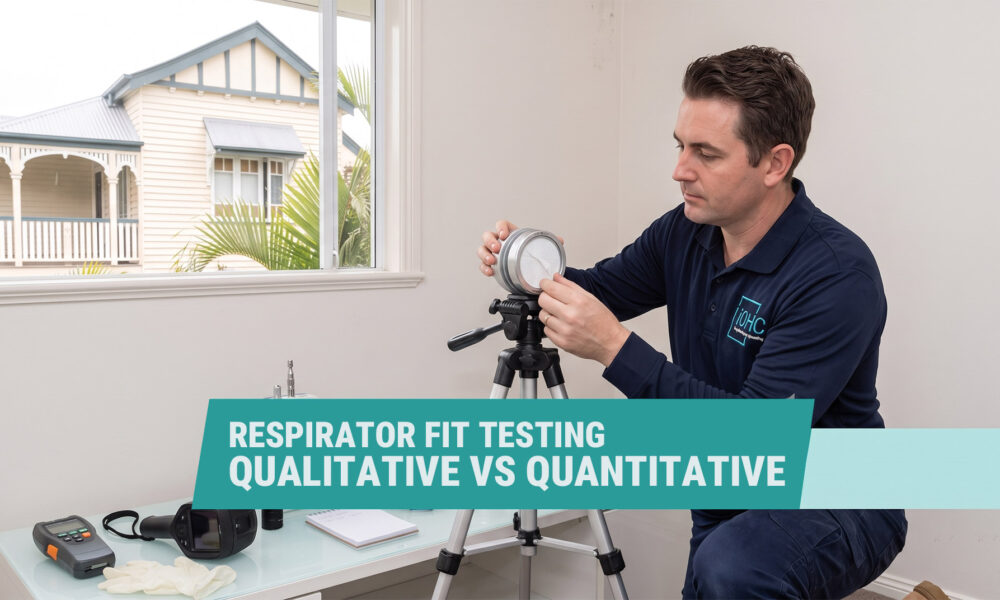
If your workplace requires staff to wear tight-fitting respirators – for silica dust, asbestos removal, welding fumes, or any other airborne hazard – fit testing isn’t optional. A respirator that hasn’t been fit tested on the specific wearer offers no guarantee of protection, regardless of how good the product is on paper.
But there are two recognised fit testing methods in Australia, and they’re not interchangeable. This guide explains the difference between qualitative and quantitative respirator fit testing, what AS/NZS 1715:2009 requires, and how to work out which method applies to your situation.
Why Respirator Fit Testing Matters
A respirator is only as effective as its seal. Manufacturers test and rate respirators in controlled conditions, but every face is a different shape, and even a small gap around the seal can let unfiltered air bypass the filter media entirely. Facial hair, weight changes, dentures, and even the specific make and model of respirator can all affect how well a given mask seals on a given person.
Fit testing exists to verify, on an individual basis, that the respirator a worker has been issued actually protects them – not just that the product is rated to do so in theory.
Qualitative Fit Testing (QLFT): How It Works
Qualitative fit testing is a pass/fail method that relies on the wearer’s own senses. A test agent with a distinct taste, smell, or irritant property – commonly saccharin (sweet taste), Bitrex (bitter taste), isoamyl acetate (banana-like smell), or irritant smoke – is introduced around the outside of the respirator while the wearer performs a series of standardised exercises, including normal breathing, deep breathing, head movements, talking, and bending over.
If the wearer detects the test agent at any point, the respirator has failed the seal test. If they detect nothing throughout the exercise sequence, it passes.
Qualitative testing is faster and less expensive than quantitative testing, but because it depends on subjective detection, it’s considered less precise. Under AS/NZS 1715:2009, its use is restricted – it’s generally only permitted for certain negative-pressure, air-purifying respirators, and only in lower-risk exposure scenarios.
Quantitative Fit Testing (QNFT): How It Works
Quantitative fit testing replaces subjective detection with a numerical, instrument-measured result. The most common method in Australia uses a particle-counting instrument – such as a TSI Portacount – connected to the respirator via a probe. The instrument measures the concentration of ambient particles outside the mask and compares it to the concentration that leaks in through the seal.
The result is expressed as a fit factor: a number representing how many times cleaner the air inside the respirator is compared to the air outside. A half-face respirator generally needs to achieve a minimum fit factor of 100 to pass; a full-face respirator needs a minimum of 500.
Because quantitative testing produces an objective, repeatable, documented result, it can be used for any tight-fitting respirator – half-face, full-face, or powered air-purifying – and is widely regarded as the more rigorous and defensible method, particularly for high-risk exposures like respirable crystalline silica.
Qualitative vs Quantitative: Side-by-Side
- Method: Qualitative uses taste/smell/irritant detection. Quantitative uses an instrument to measure actual particle leakage.
- Result type: Qualitative is pass/fail. Quantitative produces a numerical fit factor.
- Objectivity: Qualitative relies on the wearer’s senses and self-reporting. Quantitative is instrument-based and not subject to individual sensitivity differences.
- Respirator types covered: Qualitative is restricted to certain respirator types and lower-risk scenarios. Quantitative can be used for any tight-fitting respirator.
- Typical use case: Qualitative suits lower-exposure environments where permitted. Quantitative is generally required for higher-risk work such as silica-generating tasks, asbestos removal, and most workplace compliance programs.
- Environment needed: Quantitative testing requires a relatively particle-free testing environment for accurate readings, which is why it’s usually conducted in a controlled clinic setting rather than on a dusty worksite.
Which Test Does Your Workplace Need?
AS/NZS 1715:2009 (Selection, Use and Maintenance of Respiratory Protective Equipment) governs respirator fit testing in Australia, alongside AS/NZS ISO 16975-3:2023, which sets out fit testing methods specifically. Both qualitative and quantitative methods are recognised, but the standard places constraints on when qualitative testing can be used – generally limiting it to lower-risk exposure scenarios and specific respirator types.
In practice, many Australian workplaces now default to quantitative testing because it’s accepted for all respirator types, produces a defensible, documented result, and avoids the ambiguity of relying on an individual worker’s sense of taste or smell. This is particularly relevant in industries with silica exposure, where the Code of Practice on respirable crystalline silica has prompted many businesses to formalise their respiratory protection programs.
If you’re unsure which method applies to your industry, hazard, and respirator type, the safest approach is to speak with a RESP-FIT-accredited provider who can assess your specific situation rather than guessing based on general advice.
How Often Does Fit Testing Need to Be Repeated?
Under AS/NZS 1715, workers must be fit tested before first using a respirator, and then at least annually after that. A new fit test is also required whenever there’s a change that could affect the seal – significant weight gain or loss, dental work, facial scarring, or a change to a different respirator make, model, or size.
What Happens During a Fit Test Appointment
A typical quantitative fit testing appointment includes:
- A brief consultation to understand the hazard, industry, and respirator requirements
- Selection of a suitable respirator model and size for the individual’s facial characteristics
- Training in correct donning, doffing, and seal-check technique
- The fit test itself – instrument-measured, following a standardised exercise protocol
- Issue of a fit test report and record card confirming the result, respirator make/model, and date, which is valid for 12 months
Frequently Asked Questions
Qualitative testing relies on the wearer detecting a taste or smell to determine pass or fail. Quantitative testing uses an instrument to measure the actual leakage at the face seal and produces a numerical fit factor.
AS/NZS 1715:2009 permits both methods but restricts qualitative testing to certain respirator types and lower-risk exposure scenarios. Quantitative testing can be used for any tight-fitting respirator.
At least annually, and again whenever there’s a change in facial characteristics, respirator model, or size that could affect the seal.
A half-face respirator typically requires a minimum fit factor of 100, while a full-face respirator requires a minimum of 500 under quantitative testing.
It depends on the exposure level. Qualitative testing is generally limited to lower-risk exposure scenarios, and many silica-related work activities require quantitative testing instead.
Yes. Facial hair along the seal line of the respirator will compromise the fit and can cause a test to fail, regardless of which method is used.
Book Quantitative Respirator Fit Testing with IOHC
IOHC is RESP-FIT accredited and provides quantitative respirator fit testing using Portacount equipment, suitable for construction, healthcare, manufacturing, mining, and quarrying industries across Brisbane. Every fit test includes training in correct respirator use and a fit test report and record card on completion.
Contact IOHC today to book fit testing for your team, or learn more about our Fit Testing services.
Disclaimer – The information in this blog is for informational purposes only and is not intended as medical/financial/legal advice. Always consult with a professional before making any decisions based on this information. No guarantees or warranties are expressed by IOHC about the accuracy of the information contained in the blogs.