Workplace hazards are not always visible. Dust, fumes, vapours, gases, noise and other occupational hazards can expose workers without producing obvious warning signs. In many workplaces, understanding whether workers are being exposed to potentially harmful levels requires more than a visual inspection – it requires systematic assessment and, where appropriate, workplace exposure monitoring.
A workplace exposure assessment helps employers understand what hazards are present, who may be exposed, how much exposure is occurring and whether existing controls are working effectively.
This is where an occupational hygienist plays an important role. Using workplace observations, sampling techniques, monitoring equipment and exposure data, occupational hygienists can assess worker exposure and provide practical recommendations to help businesses manage health risks.
What Is a Workplace Exposure Assessment?
A workplace exposure assessment is a systematic process used to identify and evaluate workers’ exposure to health hazards during their work activities.
The assessment may consider chemical, physical or biological hazards depending on the workplace and the tasks being performed.
Examples include:
- Dust and respirable crystalline silica
- Welding fumes
- Solvents and volatile organic compounds (VOCs)
- Diesel particulate matter
- Noise
- Vibration
- Heat stress
- Biological contaminants
- Other airborne contaminants
The objective is not simply to identify whether a hazard exists. An occupational hygienist also considers how workers interact with the hazard, how frequently exposure occurs, the duration of exposure and whether existing controls are adequate.
This information can then be used to determine whether further monitoring or control measures are necessary.
Why Is Workplace Exposure Assessment Important?
A workplace may appear clean and well managed while still exposing workers to hazardous substances or physical agents.
For example, a worker may spend several hours performing a task that generates fine airborne particles. The dust may not always be visible, but workers could still be exposed to respirable particles.
Similarly, noise exposure can vary significantly throughout a working day depending on the equipment being used, the worker’s location and the duration of each task.
Workplace exposure assessment provides employers with objective information rather than relying solely on assumptions.
The results can help businesses:
- Identify workers or tasks with potentially significant exposure.
- Understand the level and pattern of workplace exposure.
- Determine whether existing controls are effective.
- Identify areas requiring additional investigation.
- Compare measured exposure with applicable workplace exposure standards.
- Develop appropriate control measures.
- Establish an ongoing occupational hygiene monitoring program.
IOHC explains that occupational health risk assessments can include document review, workplace walkthroughs, hazard identification, occupational hygiene monitoring and control recommendations.
What Does an Occupational Hygienist Do During an Exposure Assessment?
The process normally begins before any samples are collected.
An occupational hygienist first needs to understand the workplace, the tasks being performed and the potential sources of exposure.
1. Review Workplace Information
The assessment may begin with a review of relevant workplace information, such as:
- Workplace activities and processes
- Chemicals and materials used
- Safety Data Sheets (SDS)
- Existing risk assessments
- Previous monitoring results
- Workplace complaints or health concerns
- Control measures currently in place
- Worker numbers and work patterns
This initial information helps the hygienist determine which hazards may require further investigation.
2. Conduct a Workplace Walkthrough
A site inspection allows the occupational hygienist to observe actual work activities.
The hygienist may look at:
- How materials are handled
- How equipment is operated
- Where contaminants are generated
- Ventilation and extraction systems
- Worker positioning
- Duration and frequency of tasks
- Existing engineering and administrative controls
- Personal protective equipment being used
Spot measurements may also be useful during the initial assessment. IOHC notes that its consultants may conduct spot checks for dust, VOCs and noise during workplace walkthroughs to identify potentially high-exposure areas or tasks.
3. Identify Workers and High-Risk Tasks
Not every worker in a workplace necessarily has the same level of exposure.
An occupational hygienist considers the similar exposure group (SEG) concept, grouping workers who have comparable exposure profiles based on their tasks, work environment and exposure patterns.
For example, workers who regularly operate a particular process may have a substantially different exposure profile from office staff working in the same facility.
Identifying these groups helps ensure that monitoring is focused on the workers and activities most relevant to the assessment.
How Is Worker Exposure Measured?
The monitoring method depends on the hazard being assessed and the purpose of the investigation.
For airborne contaminants, occupational hygienists may use personal exposure monitoring, static or area monitoring and real-time monitoring.
Personal Exposure Monitoring
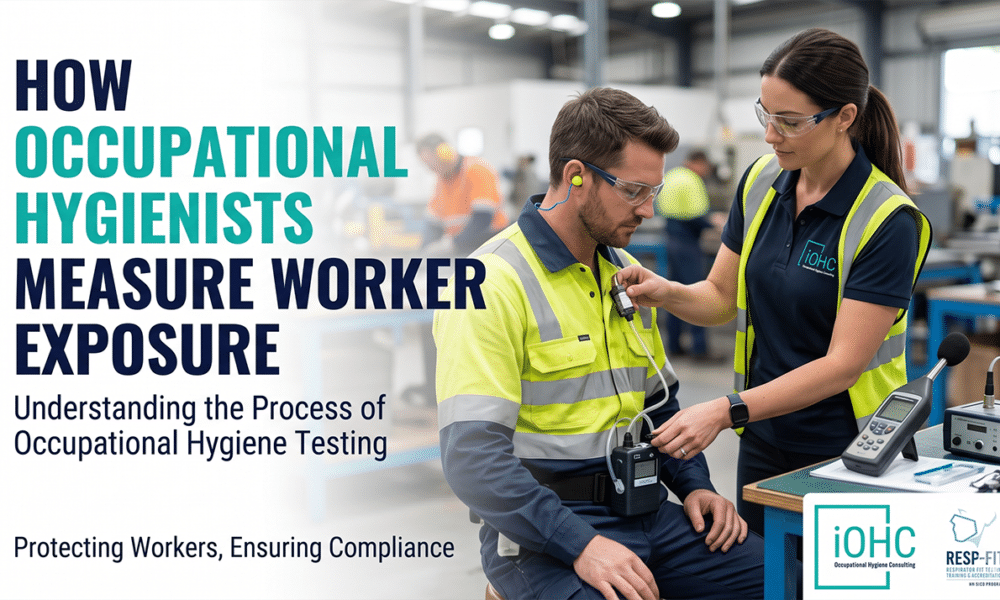
Personal exposure monitoring is designed to estimate the concentration of a contaminant in the worker’s breathing zone during their work activities.
Depending on the hazard, a sampling device may be worn by the worker during part or all of a work shift.
This approach is particularly useful when the objective is to understand the exposure experienced by an individual worker.
For example, personal monitoring can be used to assess exposure to airborne dust, silica or other contaminants.
The sampling results can then be analysed and compared with relevant workplace exposure standards where applicable.
Static or Area Monitoring
Static monitoring measures contaminant concentrations at a particular location rather than directly measuring an individual worker’s exposure.
It can help identify:
- Areas where contaminant concentrations are elevated.
- Potential sources of exposure.
- Differences between workplace locations.
- Whether controls are reducing airborne concentrations.
- Areas that may require additional investigation.
However, static monitoring does not necessarily represent an individual worker’s exposure.
This distinction is important. IOHC’s existing silica monitoring guidance explains that static monitoring can help identify high-dust areas and evaluate controls, but its results should not be treated as personal exposure measurements for compliance purposes.
Static or Area Monitoring
Static monitoring measures contaminant concentrations at a particular location rather than directly measuring an individual worker’s exposure.
It can help identify:
- Areas where contaminant concentrations are elevated.
- Potential sources of exposure.
- Differences between workplace locations.
- Whether controls are reducing airborne concentrations.
- Areas that may require additional investigation.
However, static monitoring does not necessarily represent an individual worker’s exposure.
This distinction is important. IOHC’s existing silica monitoring guidance explains that static monitoring can help identify high-dust areas and evaluate controls, but its results should not be treated as personal exposure measurements for compliance purposes.
Real-Time Monitoring
Real-time instruments can provide immediate information about changes in exposure levels.
This can be particularly useful when an occupational hygienist needs to identify which activities or processes are generating elevated concentrations.
Real-time monitoring may help identify:
- High-exposure tasks
- Changes during different stages of a process
- The effectiveness of engineering controls
- Opportunities to modify work practices
It can also help determine where more detailed personal exposure monitoring may be appropriate.
Exposure Assessment Is More Than Air Monitoring
Although airborne contaminants are an important part of occupational hygiene, workplace exposure assessment can cover a much broader range of hazards.
Depending on the workplace, an occupational hygienist may assess:
Chemical Hazards
These may include dust, fumes, vapours, gases, solvents, VOCs and other hazardous substances.
Physical Hazards
These can include noise, vibration, heat and radiation.
Biological Hazards
Depending on the workplace, biological hazards may include bacteria, mould and other biological contaminants.
IOHC provides occupational hygiene monitoring and assessment services across chemical, physical and biological hazards, including dust, silica, welding fumes, diesel particulate matter, VOCs, noise, vibration and radiation.
How Are Exposure Monitoring Results Interpreted?
Collecting a sample is only one part of the assessment.
Once monitoring has been completed, the results need to be interpreted in the context of the worker’s tasks, exposure duration and applicable workplace exposure standards.
An occupational hygienist may consider:
- The measured concentration or exposure level.
- Duration of exposure.
- The worker’s tasks and activities.
- Existing control measures.
- Variations in exposure throughout the workday.
- Relevant workplace exposure limits.
- Whether additional monitoring is required.
The results can help determine whether exposure is adequately controlled or whether further action should be considered.
It is important that monitoring results are not interpreted in isolation. A single measurement may not always represent normal workplace conditions, particularly where processes, tasks or worker activities vary significantly.
What Happens If Exposure Is Too High?
If monitoring identifies an exposure concern, the next step is to determine how the risk can be reduced.
The preferred approach is generally to consider controls that reduce exposure at its source rather than relying exclusively on personal protective equipment.
Depending on the hazard, controls may include:
- Eliminating the hazardous process where practicable.
- Substituting hazardous materials with safer alternatives.
- Engineering controls such as local exhaust ventilation.
- Isolation of workers from the hazard.
- Changes to work methods or procedures.
- Maintenance of equipment and ventilation systems.
- Administrative controls.
- Appropriate respiratory or personal protective equipment.
An occupational hygienist can help employers identify practical controls based on the source and pathway of exposure.
Why Should Exposure Assessments Be Repeated?
Workplace exposure should not necessarily be considered a one-time assessment.
Changes to the workplace can change worker exposure.
For example, reassessment may be appropriate when:
- New equipment or processes are introduced.
- Different materials or chemicals are used.
- Production volumes change.
- Engineering controls are modified.
- Workers report concerns.
- Monitoring results indicate an exposure issue.
- Workplace conditions change significantly.
- Existing controls need to be verified.
Ongoing monitoring can help determine whether controls continue to perform effectively.
IOHC describes occupational health risk assessment as a process that can also be used to develop an occupational hygiene monitoring program for ongoing measurement of workplace exposures.
Benefits of Professional Occupational Hygiene Services
Conducting a workplace inspection can identify obvious hazards, but determining actual worker exposure often requires specialist knowledge and appropriate monitoring equipment.
Professional occupational hygiene services can provide businesses with a structured approach to identifying hazards, assessing exposure and recommending controls.
An experienced occupational hygienist can help connect three important stages:
Identify → Measure → Control
First, potential hazards are identified. Next, exposure is measured where appropriate. Finally, the results are used to determine whether existing controls are sufficient or additional measures are needed.
This evidence-based approach can help businesses make better-informed decisions about workplace health risks.
When Should a Business Arrange a Workplace Exposure Assessment?
There is no single trigger that applies to every workplace.
Businesses should consider an exposure assessment when workers may be exposed to hazardous substances or physical agents, particularly where exposure levels are uncertain or existing controls need to be verified.
It may also be appropriate when:
- Introducing a new process.
- Starting work with a hazardous substance.
- Investigating worker concerns.
- Reviewing an existing control strategy.
- Responding to changes in workplace conditions.
- Establishing a baseline exposure profile.
- Verifying the effectiveness of control measures.
A proactive assessment can provide useful information before an exposure problem becomes a more serious workplace health issue.
How IOHC Can Help With Workplace Exposure Assessment
IOHC provides occupational hygiene consulting and monitoring services designed to help businesses identify, assess and manage workplace health hazards.
Its occupational hygiene services cover a range of chemical, physical and biological hazards, with assessments tailored to workplace conditions and exposure risks.
The team can assist with workplace assessments, exposure monitoring and recommendations for appropriate controls.
If you are unsure whether your workplace requires exposure monitoring or want to review existing exposure controls, speaking with a qualified occupational hygienist can help you determine the appropriate next step.
Learn more about IOHC’s Occupational Hygiene Services or Contact IOHC to discuss your workplace exposure assessment requirements.
Conclusion
Workplace exposure assessment provides employers with a clearer understanding of how workers may be exposed to occupational health hazards.
Rather than relying on assumptions, an occupational hygienist can assess workplace activities, identify potential exposure sources, select appropriate monitoring methods and interpret the resulting data. The findings can then be used to determine whether existing controls are effective and where improvements may be required.
From airborne contaminants and chemical exposures to noise, heat and other workplace hazards, a structured exposure assessment can form an important part of an effective occupational hygiene program.
For businesses looking to better understand and manage workplace exposure risks, professional occupational hygiene services can provide the technical expertise and evidence needed to make informed decisions about worker health and safety.
Disclaimer – The information in this blog is for informational purposes only and is not intended as medical/financial/legal advice. Always consult with a professional before making any decisions based on this information. No guarantees or warranties are expressed by IOHC about the accuracy of the information contained in the blogs.